
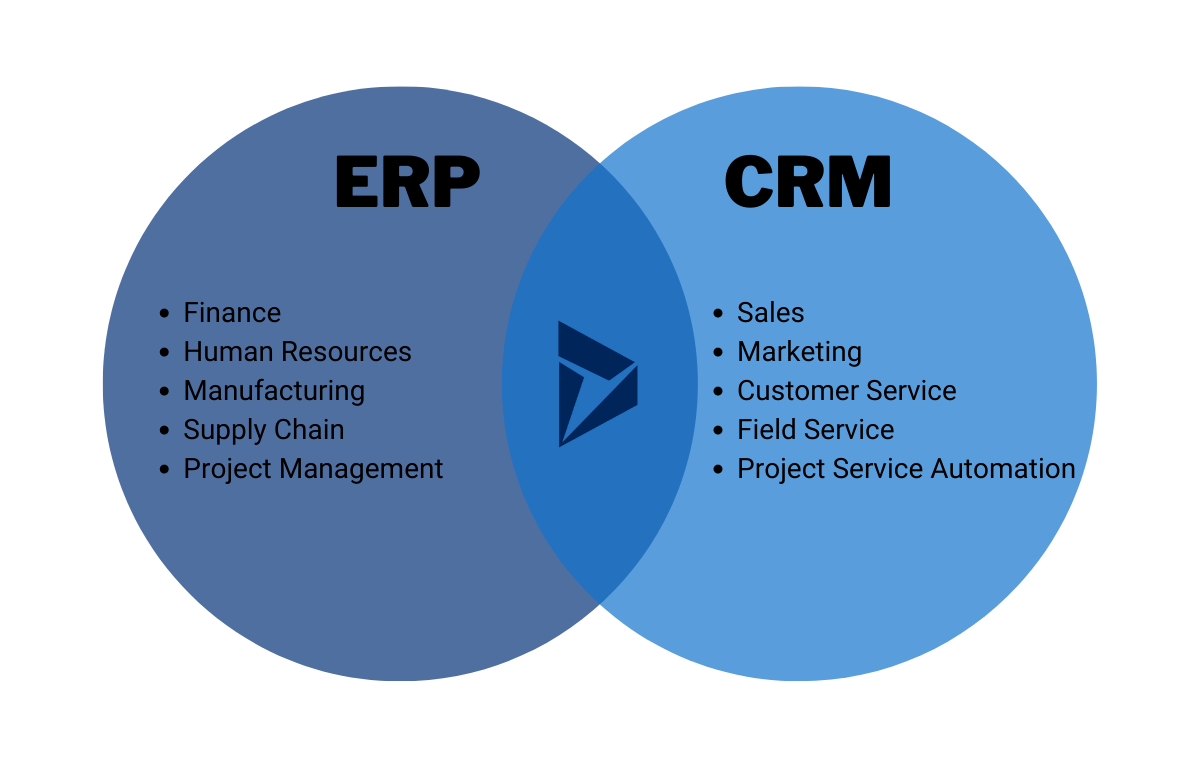
Most executives think of software in a functional rather than a strategic and architectural way (what does this button do?!) The ERP system vs CRM debate is about maximizing for inside or outside.Both platforms focus on data being centralized, but the ERP system vs CRM question is about optimizing for inside or outside. These leads lead to expensive, fragmented “Franken-stacks” which limits Enterprise scalability.
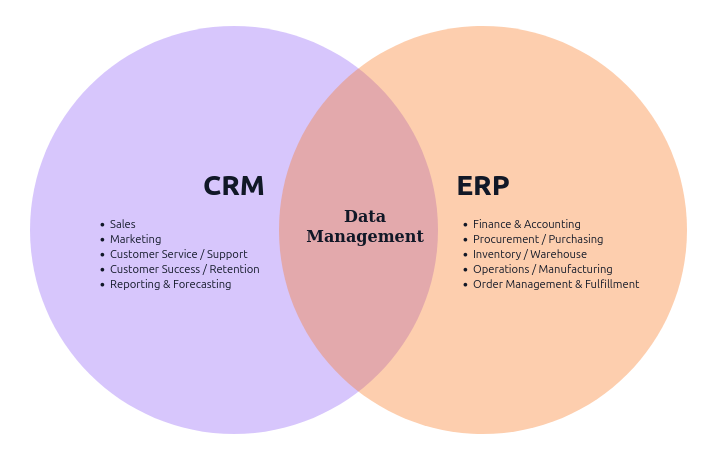
Front-Office Revenue vs. Back-Office Profitability
While an ERP system handles back office functions such as finance and the supply chain, a CRM is used to manage front office functions such as sales and customer engagement. The main difference is their goal – ERP is about cutting costs by using efficiency, while CRM is about generating revenue from relationship management.
An ERP system is used to manage back-office processes like finance and supply chain while a CRM is used for front-office processes like sales and customer engagement. The difference is in what they’re trying to achieve: ERP aims to reduce costs by increasing efficiency, while CRM aims to increase revenue by managing relationships.
- CRM: Marketing automation, contact management, and support tickets.
- ERP: Inventory, General Ledger (GL) and human resources.
- One promises and the other makes it possible for the business to keep its promise – that is, maintain a profitable margin.
Lead-to-Order vs. Order-to-Cash Workflows
A CRM’s life cycle starts where an ERP’s begins. The Lead-to-Order (L2O) process is a sequence of steps that trace a prospect from initial marketing contact to the last order placed. After reaching the ‘Closed-Won’ stage, the ERP enters into the Order-to-Cash (O2C) stage. This includes the recognition of revenue, inventory depletion and shipping. Financial reporting will not have the necessary audit trails for compliance with GAAP if your CRM attempts to do your O2C.
Behavioral Sentiment vs. Transactional Truth
CRM data can be subjective and qualitative. It records a client’s state of mind, style of communication and the “probability” of the deal closing. An ERP system however works with absolute truths, quantitative truths. Instead, it doesn’t bother to check out the feelings of a customer, it’s only concerned with whether the invoice has been paid or not, and what the Cost of Goods Sold (COGS) is. It is important to connect these two together through API integration without causing data silos arising from departmental differences.
External Stakeholders vs. Internal Resources
The primary user of a CRM is an outside individual like a salesperson. Their objective is to increase the Lifetime Value (LTV) and minimise the churn. The typical user of ERP is an internal user, such as a warehouse manager, accountant or HR specialist. The teams are responsible for managing all internal assets, from raw material to payroll, using this system. A CRM is concerned with tracking the customer’s pulse, an ERP tracks the company’s internal pulse, and a spreadsheet is not an appropriate solution in either case.
Risk Mitigation vs. Opportunity Management
ERPs are “bet-the-company” initiatives. When it doesn’t work, the company ceases shipping products. It is more or less a risk minimization and standardization issue. Focus of CRM Implementation is Opportunity Management. A CRM failure is irritating: it means losing leads and not being able to see what’s happening with sales. But it is not necessarily the end of business. While ERPs are designed to adhere to strict business rules and maintain data integrity, CRMs provide the flexibility necessary in a fast-paced and dynamic sales landscape.
ERP system vs CRM is a decision that needs to be taken after realizing that growth and efficiency go hand in hand. It is important for the enterprises to incorporate both of these and break barriers between them and establish a “Single Source of Truth. Leaders can balance financial discipline with sales agility, and ensure their company is profitable as well as being financially driven.
One response to “5 Key Differences Between ERP system vs CRM”
[…] Enterprise software procurement is often a lesson in expensive regret. Most sales leaders are looking for a magic bullet when choosing a new CRM, only to end up with a digital filing cabinet their team neglects. To achieve success, you need to get past the glossy marketing decks and focus on how data really flows within your organization. […]